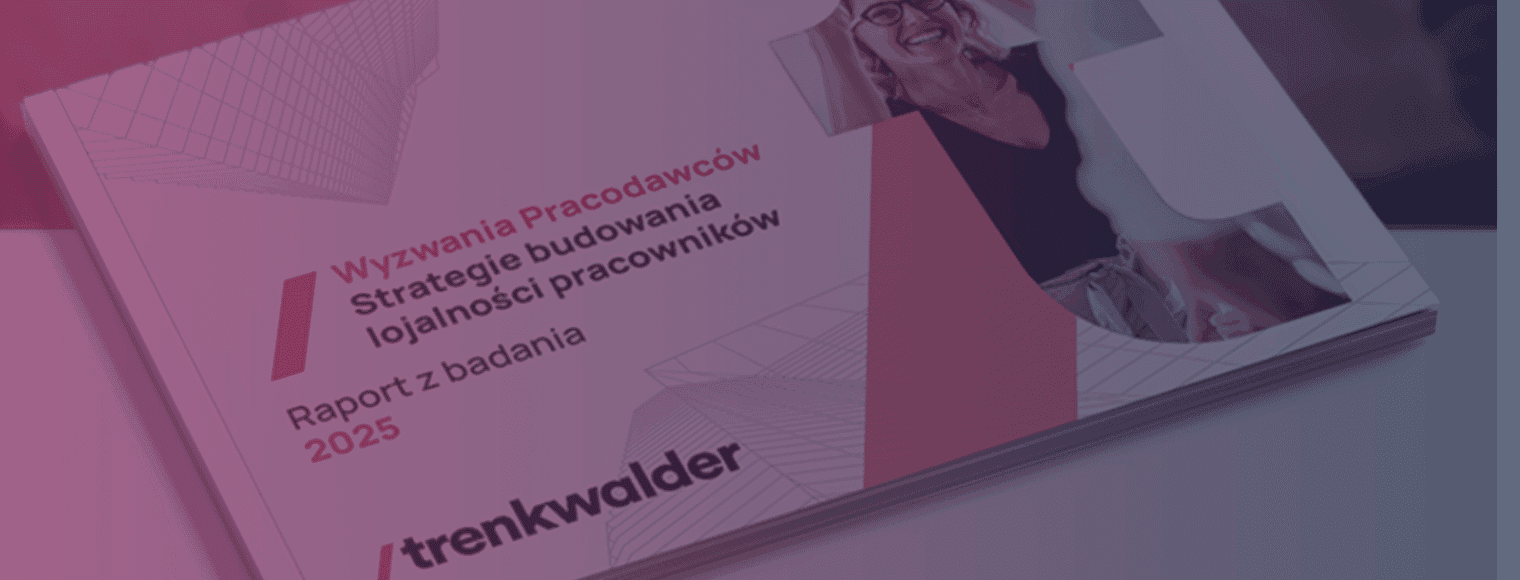
2025 in the labor market is a year full of contradictions – although Poland ranks among the top five EU countries with the lowest unemployment (5.4%), sentiment among employers is not optimistic. Rising employment costs, staff shortages, stress, difficulties in retaining employees for longer periods and strengthening their loyalty – as shown by a report from the employment agency Trenkwalder Polska, these are currently the biggest challenges for Polish employers, which will not disappear quickly in 2026.
According to the Trenkwalder Polska agency report “Employers’ Challenges. Employee Loyalty-Building Strategies”[1], the mood among entrepreneurs in Poland today is moderately optimistic.
– Labor costs rising for several years, staffing and competency shortages pose a real challenge for employers. These are everyday problems that often push the development of a long-term HR strategy based on employee loyalty and engagement into the background. The result is turnover and difficulty in acquiring the right candidates. Added to this is the pressure to adapt company processes to the pace of the accelerating digital revolution so as not to fall behind the competition – says Ewelina Glińska-Kołodziej, President of the Trenkwalder Polska employment agency and Member of the Management Board of the Polish HR Forum.
THE MOST IMPORTANT CHALLENGES FOR POLISH ENTREPRENEURS
Research conducted by Trenkwalder Polska in cooperation with the Openfield research studio among 500 employees and 500 employers from the private sector, across 29 industries – from construction and real estate, through banking, finance, media and advertising, IT and advanced technologies, to industry, trade, transport, forwarding, logistics, and business services – showed that the main pain points of Polish employers are: high labor costs, burned-out and stressed employees, staffing shortages and a shortage of qualified workers, high turnover, and difficulties in building employee loyalty.
HIGH LABOR COSTS
The conducted research showed that nearly half of surveyed entrepreneurs (46.9%) pointed to high labor costs, which have been steadily increasing in recent years. Owners of small companies feel this particularly acutely, with as many as 57.5% indicating rising financial burdens related to employing workers as the main obstacle to company growth. What is more, as many as three-quarters of respondents (76.4%) consider rising labor costs a major or very major challenge, while only 4.3% downplay the significance of this problem compared to other difficulties. There is no doubt, however, that the problem is significant.
– The fiscal burdens on Polish employers are enormous and each year absorb an increasingly larger part of company revenues. Statistics Poland’s employment cost index in Q4 2024 rose by nearly 14% year-on-year[2]. This means that within 12 months labor costs in Polish companies (including, among others, wages, contributions, and additional benefits) increased by nearly 1/7 – indicates Ewelina Glińska-Kołodziej.
STRESS AND EMPLOYEE BURNOUT
The second most frequently indicated challenge for today’s employers is the need to manage rising employee burnout and stress, which makes it harder for them to carry out assigned tasks. Every third surveyed manager (33.2%) pointed to the problem of employees’ mental condition, indicating it as an important (41.2%) or very important (25.5%) challenge for company operations. Polish employees are, in fact, one of the most stressed nations, as confirmed by research available on the market, according to which as many as every second Pole experiences severe stress at work.
– As many as 1/3 of employers pointed to the problem of employee stress and burnout. Moreover, this problem is visible primarily in large enterprises, where more than 43% of surveyed decision-makers and HR department representatives recognize its significance. This may be related to greater employee anonymity in large companies and their depersonalization, which may intensify feelings of frustration and discouragement toward work – notes Ewelina Glińska-Kołodziej.
STAFF SHORTAGES AND COMPETENCY MISMATCH
High labor costs (social insurance, taxes, etc.) were indicated as painful by nearly half of respondents (46.9%). Staffing shortages are acute for 31% of surveyed enterprises, and every fourth company (27.8%) is struggling with high employee turnover.
What causes staffing shortages in companies? As many as 38.8% of employers pointed to a lack of qualified candidates, i.e., a competency gap. Employees, however, had a somewhat different opinion. As many as 48.7% of surveyed employees indicated wages offered by companies that are too low. This shows that employees’ financial expectations are still higher than employers’ offers, which consequently affects turnover growth. In 2025, this was a challenge for 30.4% of employers and 29.9% of employees).
– The competency gap observed by employers is not a big surprise, because education systems generally do not keep up with the fast pace of changes in the labor market. This applies both to fields such as IT and digital technologies, and to vocational education, which has been neglected and depreciated over the last thirty-odd years – says Ewelina Glińska-Kołodziej.
Respondents also indicated other causes of staffing shortages, such factors as difficulty in recruiting employees for physical and/or shift work, high candidate expectations regarding non-wage benefits, low candidate motivation to take up and stay in work, a shortage of candidates in the local labor market, limited opportunities for employee promotion or development in the company, or an excessively long and labor-intensive recruitment process.
HIGH EMPLOYEE TURNOVER
The last of the difficulties most often indicated by employers, related to noticeable staffing shortages, is high employee turnover. Nearly 28% of surveyed managers pointed to it. This is confirmed by analyses of the Polish Economic Institute (PIE), which indicate that each year, on average, 10% of employees (nearly 1.4 million people) leave or change jobs[3].
– Young employees are particularly prone to frequent job changes, as they have high financial requirements and expect flexible working hours and the possibility of maintaining work-life balance. Companies are therefore increasingly forced to attract new employees not only through attractive salaries, but also by enriching development offerings and caring for organizational work culture, which – as our research has shown – is becoming crucial for building loyalty and retaining employees in the longer term – emphasizes Ewelina Glińska-Kołodziej.
AUTOMATION – LARGE COMPANIES INVEST IN DIGITALIZATION, SMALL ONES PLAY FOR TIME
One of the challenges already faced by Polish employers and employees is also automation and the use of artificial intelligence in company processes. According to Trenkwalder’s research, only just under 15% of companies plan additional investments in automation and AI solutions in the near future, and another 24% will take such actions in the longer term; the need to adapt to the pace of the accelerating digital revolution puts additional pressure on entrepreneurs to develop technology and expand digital infrastructure (felt by 16.1% of employers).
The study conducted by Trenkwalder Polska confirmed that large companies are more willing to invest in digitalization and tools based on artificial intelligence (40% of surveyed companies), while small companies, often without specialized IT departments, do not place much importance on infrastructure and digital competencies. Small companies also feel relatively less pressure to automate (64% compared to 83.3% in the case of large corporations). It is worth remembering, however, that the digital tsunami is gaining momentum and only those players who are well prepared for it will stay afloat.
– In terms of automation and implementation of AI solutions, we are dealing with a two-speed labor market – large and medium-sized companies place great hopes on increasing competitiveness through introducing AI-based tools, which is why they are already implementing such solutions to a much greater extent (40% of surveyed companies). In turn, small companies, often lacking specialized IT departments, are not yet investing in additional infrastructure and digital competencies. This may result both from a relatively worse financial situation, a lack of IT specialists, and from the widespread lingering belief that “technological changes are indeed inevitable, but they will not affect our company” – emphasizes Ewelina Glińska-Kołodziej.
OUTLOOK FOR 2026
The current year is ending under pressure from high labor costs, staffing shortages, and ongoing digitalization projects and implementation of technological tools.
– Observing upcoming legislative changes regarding PIP powers, which will stiffen the labor market, as well as obligations resulting from the EU pay equality directive, we expect this mood to continue in 2026, when labor costs will keep rising, competency gaps will widen, and ongoing technology investments will not yet bring tangible and measurable effects. In practice, this means that solutions combining flexibility with predictability are becoming increasingly important. Therefore
in talks with employers we will draw attention to the potential of temporary work as a tool that allows safe responses to volatility and optimization of employment costs. At the same time, we want to show how modern technologies in HR – already used in our organization today – actually shorten employee and client service times as well as candidate acquisition, and help build their satisfaction and engagement.” – summarizes Ewelina Glińska-Kołodziej, President of the Trenkwalder Polska employment agency and Member of the Management Board of the Polish HR Forum.
Informational material by Trenkwalder Polska
[1] “Employers’ Challenges. Strategies for Building Employee Loyalty,” Trenkwalder, November 2025.
[2] https://stat.gov.pl/obszary-tematyczne/rynek-pracy/pracujacy-zatrudnieni-wynagrodzenia-koszty-pracy/indeks-kosztow-zatrudnienia-w-kwartalach-2024-r-,26,3.html
[3] “Employee Turnover in Poland,” Polish Economic Institute.
" transform="translate(2.833 8.5)" width="28.33333px"/><path d="M 0.022 14.132 C 0.115 18.475 0.161 20.646 1.764 22.255 C 3.366 23.863 5.596 23.919 10.057 24.031 C 12.806 24.101 15.528 24.101 18.277 24.031 C 22.737 23.919 24.967 23.863 26.57 22.255 C 28.172 20.646 28.218 18.475 28.311 14.132 C 28.341 12.736 28.341 11.348 28.311 9.951 C 28.218 5.608 28.172 3.437 26.57 1.828 C 24.967 0.22 22.737 0.164 18.277 0.052 C 15.528 -0.017 12.806 -0.017 10.057 0.052 C 5.596 0.164 3.366 0.22 1.764 1.828 C 0.161 3.437 0.115 5.608 0.022 9.951 C -0.007 11.348 -0.007 12.736 0.022 14.132 Z" fill="transparent" height="24.083362500271463px" id="S0q8vHdPK" stroke-dasharray="" stroke-linecap="butt" stroke-linejoin="round" stroke-width="2.5" stroke="rgb(255, 255, 255)" transform="translate(2.833 4.961)" width="28.333351251416875px"/></svg>)
" height="30.459721732365058px" id="NLdB3v0Tr" transform="translate(1.77 1.773)" width="30.459299043458806px"/></svg>)
" transform="translate(12.092 9.211)" width="9.916699999999999px"/><path d="M 11.333 0 C 5.074 0 0 5.125 0 11.448 C 0 15.063 1.417 17.874 4.25 20.384 C 6.247 22.154 9.881 25.95 11.333 28.333 C 12.859 25.998 16.42 22.154 18.417 20.384 C 21.25 17.874 22.667 15.063 22.667 11.448 C 22.667 5.125 17.593 0 11.333 0 Z" fill="transparent" height="28.33316px" id="IqmW6KOOc" stroke-dasharray="" stroke-linecap="butt" stroke-linejoin="round" stroke-width="2.5" stroke="rgb(255, 255, 255)" transform="translate(5.667 2.836)" width="22.666670000000003px"/></svg>)