
The production and logistics sectors continue on a cautious course. Rising costs and difficulties in attracting candidates mean that companies are focusing on retaining experienced staff and limiting turnover. Wages are increasing, although at varying rates depending on the position and region; at the same time, transparency of pay rules and benefits systems is playing an increasingly important role, according to the Gi Group report “Wages of Blue-Collar Workers in Production and Logistics.” Employment stability, income predictability, and the real value of non-wage benefits are now becoming key elements of the competitiveness of job offers.
Continued caution among companies in employment planning
The situation in industry and logistics remains relatively stable; business climate indicators have improved compared with last year – in November this year, they rose to -7.9 in manufacturing (compared with -11.7 a year earlier), and to -2.5 in transport and warehousing (-3.9 in November 2024).
The condition of these sectors is affected by rising costs, weak demand—especially in industry—and uncertainty about further economic development. As a result, companies are focusing on maintaining operational continuity and further process optimization, while taking a cautious approach to recruitment decisions. Employment in manufacturing stood at 2.31 million full-time positions in October 2025, a year-on-year decrease of 0.4%. In transport and warehousing, 650 thousand people were employed at the same time, i.e., 1% fewer than a year earlier. The job vacancy rate in Q2 2025 was 0.78%, lower by 0.11 percentage points year on year. In practice, this means 95.7 thousand vacancies, 15.1 thousand fewer than a year earlier.
– Companies’ caution mainly stems from cost pressure and difficulties in maintaining profitability. Increases in the minimum wage, rising energy costs, and inflation are forcing companies to continue optimizing processes and improving efficiency with unchanged resources. High labor costs also limit the possibility of further wage increases, which makes it harder to compete for candidates in many local markets – emphasizes Anna Wesołowska, Managing Director of Gi Group.
Wages in manufacturing and logistics are rising, but unevenly
Data from the Gi Group report “Wages of blue-collar workers in manufacturing and logistics” show that caution in staffing decisions does not translate into wage stagnation; pay in the manufacturing and logistics sectors is increasing. According to Statistics Poland (GUS), in October 2025 the average wage in the enterprise sector was PLN 8,865.12 gross, which represents a 6.6% year-on-year increase. In manufacturing, wages rose by 8%, reaching PLN 8,482.18 gross, while in transport and warehousing, despite a slightly higher average of PLN 8,664.44, growth dynamics were much lower at 2.4% year on year. The data also indicate that median wages in manufacturing and logistics remain below the national level. In May 2025, they were PLN 6,834.99 in manufacturing and PLN 6,914.88 in logistics, respectively, while in the entire enterprise sector the median stood at PLN 7,082.
Differences between average wages and the median confirm that a wide pay spread persists: the highest earnings are achieved by specialists and technical employees, while most blue-collar workers receive pay below the average. Manufacturing and logistics companies are trying to balance rising labor costs with maintaining wage competitiveness, which translates into an extensive pay grid.
– Rising labor costs and difficulties in acquiring new candidates mean that manufacturing and logistics companies are placing increasing emphasis on employment stability. Instead of expanding teams, they focus on retaining experienced employees and reducing turnover. In addition, high salary expectations and growing employee awareness are forcing greater transparency of pay rules and the development of benefits and bonus systems aimed at increasing loyalty and employment predictability – explains Agnieszka Zielińska, Director of the Polish HR Forum.
Differentiation of wage levels in manufacturing and logistics
In 2025, wages of blue-collar workers in manufacturing and logistics remain highly differentiated, both between individual regions of the country and between industries or qualification levels. Wage levels are influenced primarily by local labor market conditions, the degree of staffing shortages, and the nature of performed duties.
Manufacturing sector
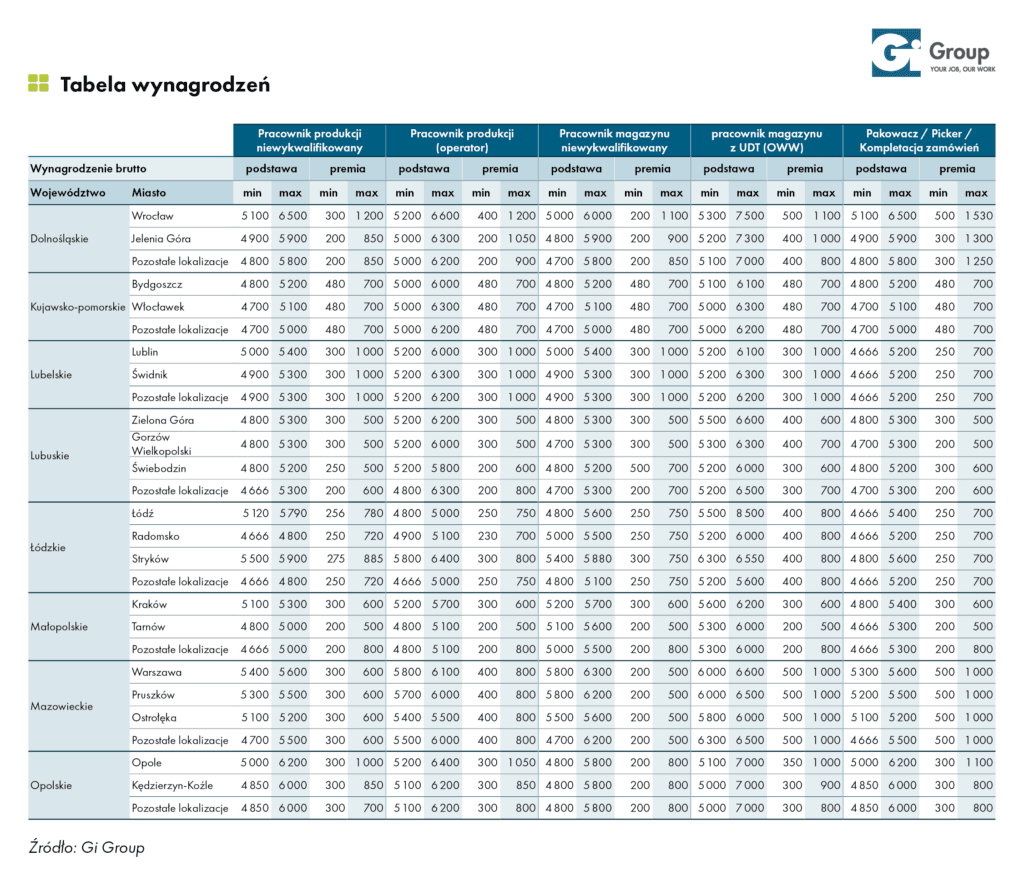
In the manufacturing industry, base pay for unskilled workers ranges from PLN 4,666 to PLN 6,500 gross. The lowest wage levels were recorded in the Warmian-Masurian and Kuyavian-Pomeranian voivodeships, where rates do not exceed PLN 5,200. The highest pay in this group occurs in the Opole, Lower Silesian, Masovian, and Greater Poland voivodeships, where it reaches PLN 6,500. The Gi Group report also indicates that in larger urban centers such as Warsaw, Poznań, or Wrocław, base rates are clearly higher than in other locations within the same voivodeships.
Base salaries of production operators range from PLN 4,666 to PLN 6,800 gross. The highest salaries were recorded in the Lower Silesian, Greater Poland, and West Pomeranian voivodeships, where base pay ranges from PLN 5,000 to PLN 6,800, while the lowest are offered in the Pomeranian and Łódź voivodeships and amount to PLN 4,666. Also in this case, clear differences can be seen between rates in large cities and smaller locations. For example, in the Silesian voivodeship in Tychy, the upper salary limit, excluding bonuses, is PLN 6,450, while in other, smaller towns in the region it is PLN 5,500.
Logistics sector
In 2025, the logistics sector also maintains significant diversity in wage levels depending on the type of position, voivodeship, and city size. Differences between the lowest and highest rates can reach approx. PLN 2,000.
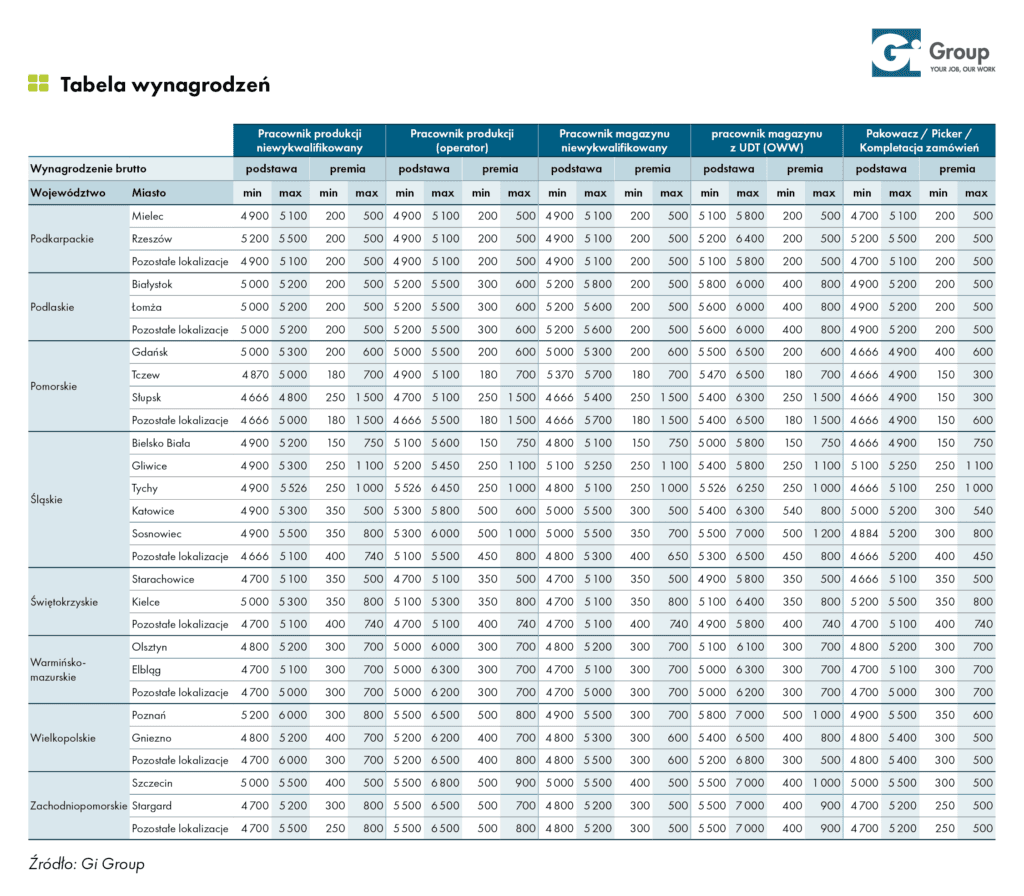
In the group of unskilled warehouse workers, base salaries range from PLN 4,666 to PLN 6,300 gross. The lowest wages are recorded in the Świętokrzyskie and West Pomeranian voivodeships, where their upper limit does not exceed PLN 5,200, while the highest are in the Masovian voivodeship, where an unskilled warehouse worker can expect pay ranging from PLN 5,500 to PLN 6,300.
In packer and picker positions, responsible for order picking, base pay is similar and ranges from PLN 4,666 to PLN 6,500. The lowest values occur in the Pomeranian voivodeship, where the maximum base wage is PLN 4,900. The highest earnings can be expected by workers from the Lower Silesian voivodeship, specifically Wrocław, where the minimum salary starts at PLN 5,100 and ends at PLN 6,500.
The highest base wages are received by warehouse workers with UDT qualifications (forklift operators), whose salaries range from PLN 4,900 to PLN 8,500. High earnings can be expected in the Lower Silesian voivodeship, where salaries fluctuate between PLN 5,100 and PLN 7,500. The highest salaries, however, were recorded in the Łódź voivodeship, with rates starting from PLN 5,200 and reaching as much as PLN 8,500. Warehouse workers with UDT qualifications have lower rates in the Podkarpackie and Świętokrzyskie voivodeships, where, excluding Rzeszów and Kielce, they do not exceed PLN 5,800.
Attractiveness of job offers – money is not everything
– The level of remuneration is a very important, though not the only, factor determining the attractiveness of job offers. Candidates increasingly assess it holistically, taking into account not only the hourly rate, but also the number of available hours, possibility of overtime, shift system, or schedule predictability. Practical issues are also important—commuting, company transport, or accommodation—especially for people from smaller towns and for foreigners – comments Weronika Ziętara, Branch Manager, Gi Group.
The hierarchy of these factors differs depending on the region. In towns where the number of job offers is limited, employment stability, a fixed number of hours, and proximity to the workplace are more important. These elements, together with team atmosphere and relationships with supervisors, often outweigh higher rates offered farther away. In regions with low unemployment and a high concentration of enterprises, where competition for employees is stronger, candidates pay more attention to benefits, development opportunities, company stability, or commuting comfort.
Pay structure – stability more important than potential bonuses
Against the backdrop of differentiated pay rates in the manufacturing and logistics industries, the Gi Group report “Wages of blue-collar workers in manufacturing and logistics” shows that just as important as earnings level is how remuneration is structured. In most cases, it consists of base pay and bonuses, with employees increasingly paying attention to the proportions between these elements.
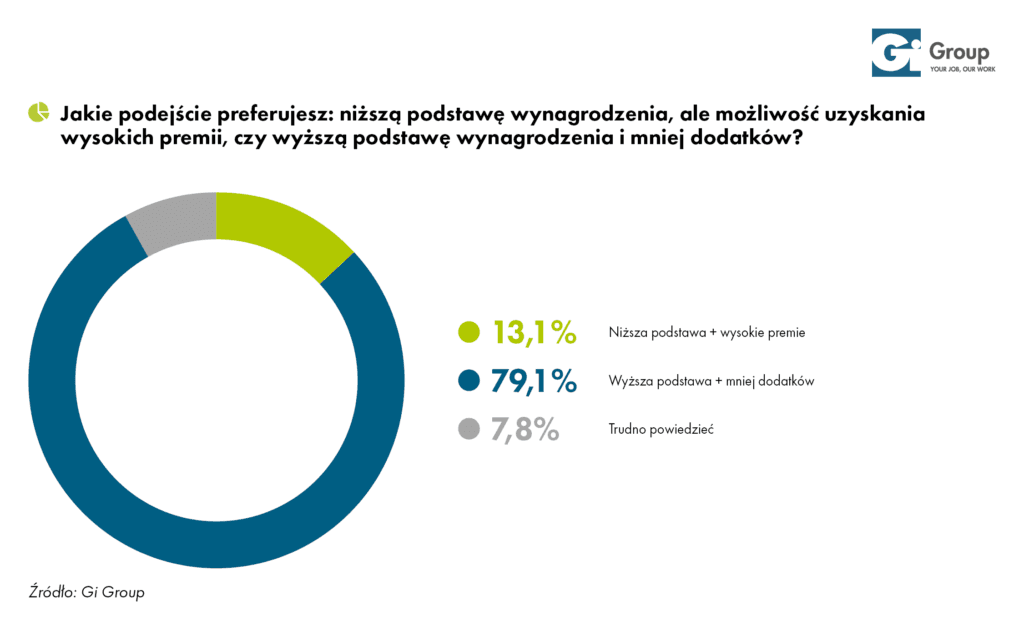
The study shows that over 79% of respondents prefer higher base pay with fewer add-ons, considering this solution more predictable and providing financial stability. Only 13.1% of respondents are willing to accept a lower base in exchange for the possibility of higher bonuses. These preferences are similar among women and men, although men (14.4%) choose a pay model with a lower base and higher bonuses slightly more often than women (11.1%). The greatest openness to this solution is shown by people aged 41–50 (17.2%) and employees with net monthly pay in the range of PLN 6,000–8,000.
– The increasing emphasis on a fixed, predictable component of remuneration is a signal that blue-collar workers expect greater financial security. Bonuses remain important, but they are not the main factor determining the attractiveness of a job offer. For companies, this is a clear indication that when designing pay systems, attention should be paid not only to the motivational nature of add-ons, but above all to income predictability, which employees expect today – explains Agnieszka Żak, Regional Director, Gi Group.
Benefits as a complement to the remuneration system
Beyond pay levels, non-wage benefits have a major impact on the attractiveness of job offers in manufacturing and logistics, and in most enterprises they have become a permanent element of the remuneration system. Employers increasingly treat them not as an image add-on, but as a real tool supporting recruitment and employee retention in conditions of growing competition for staff.
The most popular benefits include medical packages and group life insurance, which appear in nearly 100% of analyzed offers. A high share of employers (60%) also provides employee transport or commuting subsidies, which is particularly important for plants located outside large cities. Every second offer also includes employee meals, and around 40% of companies offer employee referral programs. Seasonal benefits such as holiday gift packages, additional days off, or prepaid cards appear less often – 30%.
– In the manufacturing and logistics industries, companies focus primarily on practical benefits that have real value for employees. Benefits that facilitate daily functioning and increase work safety dominate, such as transport, meals, or medical care. In shift-work conditions, this type of support becomes not only an add-on, but an element affecting employment stability and team engagement – comments Anna Wesołowska, Managing Director, Gi Group.
It is also worth noting that expectations regarding benefits vary depending on age and professional experience. For older employees, stability and health protection remain priorities, while younger generations more often seek solutions supporting professional development, flexibility, and work-life balance. Regardless of age, however, employees increasingly perceive benefits as an integral part of remuneration, not an additional privilege.
The Gi Group report “Wages of blue-collar workers in manufacturing and logistics” was prepared based on data from Statistics Poland (GUS), information from more than 60 companies with diverse business profiles, and data from recruitment portals and candidate declarations. The analysis used up-to-date data on job offers collected in October 2025, reflecting the current market situation and employer expectations. The report presents monthly base salaries in gross amounts, broken down into minimum and maximum values, as well as bonus ranges characteristic of individual positions. Additionally, it includes results of an SW Research study conducted using the CAWI method on October 9–14, 2025, among 206 employees in the manufacturing and logistics sector paid under a “base + bonus” system.
" transform="translate(2.833 8.5)" width="28.33333px"/><path d="M 0.022 14.132 C 0.115 18.475 0.161 20.646 1.764 22.255 C 3.366 23.863 5.596 23.919 10.057 24.031 C 12.806 24.101 15.528 24.101 18.277 24.031 C 22.737 23.919 24.967 23.863 26.57 22.255 C 28.172 20.646 28.218 18.475 28.311 14.132 C 28.341 12.736 28.341 11.348 28.311 9.951 C 28.218 5.608 28.172 3.437 26.57 1.828 C 24.967 0.22 22.737 0.164 18.277 0.052 C 15.528 -0.017 12.806 -0.017 10.057 0.052 C 5.596 0.164 3.366 0.22 1.764 1.828 C 0.161 3.437 0.115 5.608 0.022 9.951 C -0.007 11.348 -0.007 12.736 0.022 14.132 Z" fill="transparent" height="24.083362500271463px" id="S0q8vHdPK" stroke-dasharray="" stroke-linecap="butt" stroke-linejoin="round" stroke-width="2.5" stroke="rgb(255, 255, 255)" transform="translate(2.833 4.961)" width="28.333351251416875px"/></svg>)
" height="30.459721732365058px" id="NLdB3v0Tr" transform="translate(1.77 1.773)" width="30.459299043458806px"/></svg>)
" transform="translate(12.092 9.211)" width="9.916699999999999px"/><path d="M 11.333 0 C 5.074 0 0 5.125 0 11.448 C 0 15.063 1.417 17.874 4.25 20.384 C 6.247 22.154 9.881 25.95 11.333 28.333 C 12.859 25.998 16.42 22.154 18.417 20.384 C 21.25 17.874 22.667 15.063 22.667 11.448 C 22.667 5.125 17.593 0 11.333 0 Z" fill="transparent" height="28.33316px" id="IqmW6KOOc" stroke-dasharray="" stroke-linecap="butt" stroke-linejoin="round" stroke-width="2.5" stroke="rgb(255, 255, 255)" transform="translate(5.667 2.836)" width="22.666670000000003px"/></svg>)