
Although the labor market is currently in a stabilization phase and shows neither signs of crisis nor dynamic growth, the sentiment among specialists and managers is most often not optimistic. Professionals feel concerns related to job stability and earning potential, which translates into declining job satisfaction. Despite the uncertainty, as many as 48 percent of respondents participating in the Hays Poland survey are nevertheless considering changing jobs this year.
61 percent of specialists and managers are not satisfied with their pay. This is often due to an excessively high, inadequate workload. As a consequence, overall professional satisfaction declines.
The group of employees considering a job change due to employment instability is growing. This illustrates the feeling of uncertainty and lack of security that some of them struggle with.
Professionals expect companies to provide not only pay raises, but also open, honest communication and non-wage benefits that will allow them to take care of their well-being. Employees rank among the most valuable benefits primarily those offering additional time off and flexible work, which helps maintain work-life balance.
Employees are gradually adapting to current market conditions. Although for many of them the current moment is still not ideal for changing employers, they are gradually opening up to such a step. While some are motivated to make this decision by a sense of lack of employment stability in their current company, others are driven by growing dissatisfaction with the offer—and often also the atmosphere or relationships—at their current employer. The results of the Hays Poland survey, described in the 2026 Salary Report, show that the level of professional satisfaction among specialists and managers leaves much to be desired.
More than half of specialists and managers would like to earn more
Cautious staffing decisions in recent years, including postponed recruitment and suspended pay raises, have caused professionals to often find themselves in a situation where they not only work too much, but also do not receive adequate compensation for their efforts.

As shown by the Hays Poland survey, as many as 61 percent of specialists and managers declare that they are not satisfied with their pay. What is more, 42 percent of professionals also believe that it is not adequate to their current scope of responsibilities. As a result, this translates into lower motivation, a sense of overload, and often consideration of changing jobs.

Lack of satisfaction with pay is only one of the problems
Although dissatisfaction with earnings has consistently been employees' biggest motivator for changing jobs for years, there are many more arguments for making such a decision. As in 2025, this year again, lack of development opportunities ranked second. This reflects the high aspirations of professionals, which do not diminish even in the face of an ambiguous market situation.
At the same time, in the latest edition of the report, uncertainty of employment moved up two places on the list of reasons for wanting to change jobs, and excessive workload moved up by as many as four. On the other hand, compared with last year, such arguments as direct supervisor or office location have lost importance.
– Such changes in professionals' responses illustrate the growing uncertainty they are facing and a strong need for a sense of security and predictability regarding what they can realistically count on in their current workplace. The multitude of concerns related to professional life may also result from a lack of proper, transparent communication in companies. It is essential for maintaining motivation, good relationships, and the well-being of employees, yet in demanding business times it is sometimes neglected by organizations – notes Agnieszka Czarnecka, HR Consultancy Manager for the Central and Eastern Europe region at Hays.
Employees expect changes
Fatigue from the challenges specialists face in their current company, and the lack of signals of deterioration in the labor market situation, are prompting many professionals to be proactive and take concrete action. After years of frozen budgets, with wage stagnation or symbolic raises, many experts expect that in 2026 this situation will change and they will experience salary adjustments—if not in their current place of employment, then elsewhere.
As many as 66 percent of Hays survey respondents believe they will receive a raise in the coming months, including 12 percent who expect double-digit growth. By comparison, in 2025, 52 percent of employees expected a change in remuneration.
How will employers respond to specialists' expectations? As noted by Agnieszka Pietrasik, CEE Executive Director at Hays, although companies are planning raises, they will still remain highly cautious in shaping pay grids. – Decisions on raises will also be increasingly influenced by growing pay transparency, resulting from the planned implementation of the European Union directive. Many organizations have not yet introduced changes in this area, waiting for the draft law and specific obligations and consequences for companies. Adjusting pay grids and reporting with the new regulations in mind will be one of the greater HR challenges in the coming months – adds the expert.
If companies do not respond to employees' needs for a longer period, employees will take matters into their own hands. In this year's edition of the Hays report, 48 percent of specialists and managers declared that they are considering changing their place of employment in the near future.
Employers should act on multiple dimensions
So what can companies do to retain the best talent in the organization while also maintaining their satisfaction? One solution may be making somewhat bolder staffing decisions. Recruiting new employees to relieve current teams, as well as transparent communication about the company's strategy, are fundamentals that cannot be missing in 2026. Money will, of course, also be a major motivator for professionals.
In many cases—if not satisfying raises—non-wage benefits can do a lot of good. The Hays report shows that well-designed benefits can become a competitive advantage for companies.
– Employees care above all about benefits that increase quality of life and make it possible to maintain a balance between private and professional life. They are of great importance in recruiting and retaining talent in an organization. At the same time, there is no single universal benefit that is valuable for everyone. For each individual, that dream set of benefits looks slightly different. Employers should therefore—where possible—allow at least a small degree of choice in non-financial perks – emphasizes Agnieszka Czarnecka from Hays.
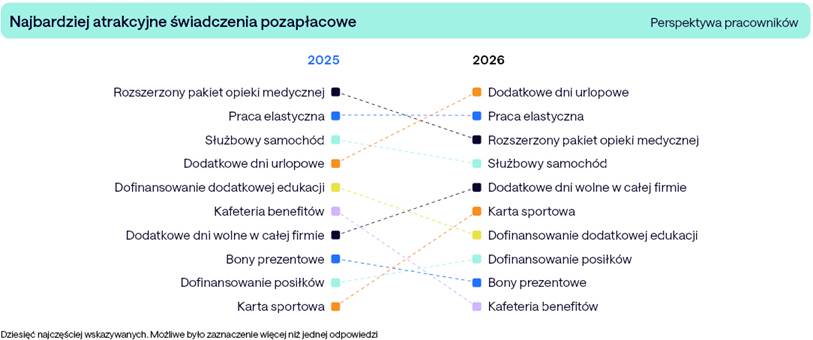
And there are many to choose from. This year's edition of the report shows that those employees care about most are: additional vacation days, which moved up by 3 places over the year, flexible work, and an extended medical care package.
Source: Hays Poland Salary Report 2026
" transform="translate(2.833 8.5)" width="28.33333px"/><path d="M 0.022 14.132 C 0.115 18.475 0.161 20.646 1.764 22.255 C 3.366 23.863 5.596 23.919 10.057 24.031 C 12.806 24.101 15.528 24.101 18.277 24.031 C 22.737 23.919 24.967 23.863 26.57 22.255 C 28.172 20.646 28.218 18.475 28.311 14.132 C 28.341 12.736 28.341 11.348 28.311 9.951 C 28.218 5.608 28.172 3.437 26.57 1.828 C 24.967 0.22 22.737 0.164 18.277 0.052 C 15.528 -0.017 12.806 -0.017 10.057 0.052 C 5.596 0.164 3.366 0.22 1.764 1.828 C 0.161 3.437 0.115 5.608 0.022 9.951 C -0.007 11.348 -0.007 12.736 0.022 14.132 Z" fill="transparent" height="24.083362500271463px" id="S0q8vHdPK" stroke-dasharray="" stroke-linecap="butt" stroke-linejoin="round" stroke-width="2.5" stroke="rgb(255, 255, 255)" transform="translate(2.833 4.961)" width="28.333351251416875px"/></svg>)
" height="30.459721732365058px" id="NLdB3v0Tr" transform="translate(1.77 1.773)" width="30.459299043458806px"/></svg>)
" transform="translate(12.092 9.211)" width="9.916699999999999px"/><path d="M 11.333 0 C 5.074 0 0 5.125 0 11.448 C 0 15.063 1.417 17.874 4.25 20.384 C 6.247 22.154 9.881 25.95 11.333 28.333 C 12.859 25.998 16.42 22.154 18.417 20.384 C 21.25 17.874 22.667 15.063 22.667 11.448 C 22.667 5.125 17.593 0 11.333 0 Z" fill="transparent" height="28.33316px" id="IqmW6KOOc" stroke-dasharray="" stroke-linecap="butt" stroke-linejoin="round" stroke-width="2.5" stroke="rgb(255, 255, 255)" transform="translate(5.667 2.836)" width="22.666670000000003px"/></svg>)